
Industry · Retail
From single-store to omnichannel — modern retail runs on modern software.
Vestval helps retail brands unify storefronts, inventory, customers and intelligence so that pricing, replenishment and personalization stop being tribal knowledge and start being software.
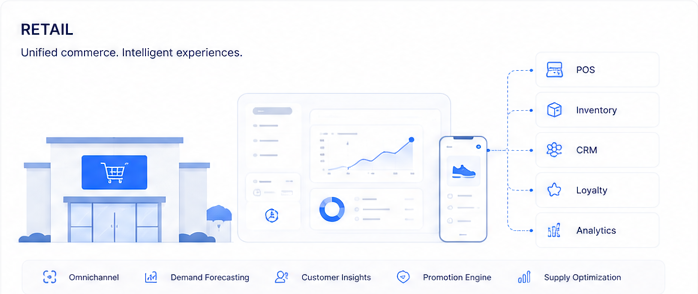
Industry overview
Retail industry overview
Retail is the most-instrumented and least-integrated industry most teams will ever work in. Point-of-sale, e-commerce, marketplaces, quick-commerce, warehousing, loyalty and finance all generate first-party signals — and almost none of them reconcile cleanly. The result is a retailer that can describe its customers in PowerPoint but cannot answer basic operational questions: what did we actually sell, what should we actually reorder, who is actually loyal?
Vestval treats retail technology as an integration problem first and an intelligence problem second. Once inventory, sales, customer and finance data live on one operating layer, every subsequent investment — AI replenishment, dynamic pricing, loyalty personalization, store labor planning — compounds. Without that layer, every initiative re-pays the same integration tax.
Operational challenges
What we hear most often.
- Inventory drift between channels and physical stores
- Loyalty data trapped inside payment terminals
- Promotion ROI invisible across channels
- Manual reorder cycles costing margin every week
How Vestval helps
Solutions, not slogans.
Unified retail ops
ERP + POS + inventory in one operating layer with real-time stock visibility.
Customer intelligence
Cohort, RFM and propensity models on first-party purchase data.
AI-driven replenishment
Forecasting that responds to seasonality, promotion and stock-out risk.
Solution map · Retail
Challenges → products → outcomes.
How operational challenges in Retail map to Vestval products and the outcomes teams typically pursue.
Challenges
Inventory drift between channels and physical stores
Loyalty data trapped inside payment terminals
Promotion ROI invisible across channels
Manual reorder cycles costing margin every week
Vestval response
Unified retail ops
ERP + POS + inventory in one operating layer with real-time stock visibility.
Customer intelligence
Cohort, RFM and propensity models on first-party purchase data.
AI-driven replenishment
Forecasting that responds to seasonality, promotion and stock-out risk.
Outcomes
From channel silos to one commerce backbone
Replace per-channel ops teams with a single inventory, pricing and customer model that every channel reads from and writes to.
From periodic reporting to live operating picture
Move from weekly sales decks to dashboards that surface margin, stock-out and labor risk in hours, not weeks.
From manual merchandising to data-assisted decisions
Augment merchant judgment with forecasting, propensity and elasticity models — without removing the merchant from the loop.
Digital transformation roadmap
Retail organizations succeed with a three-horizon roadmap: (1) foundation — consolidate the operating layer (identity, master data, finance, workflows) on a single platform; (2) intelligence — add AI-assisted decisions on the now-unified data; (3) differentiation — build proprietary capabilities as workflows and models on top. Attempting horizons in the wrong order is the single most common cause of failed transformations in retail.
Enterprise services engagement
Vestval Enterprise Services engages Retail clients through a discovery sprint, a reference-architecture design phase, an implementation phase with embedded engineers, and a managed operations phase. Every phase is fixed-scope, fixed-timeline where possible, and continuous where the business genuinely requires ongoing partnership.
Recommended products
Where the Vestval platform fits in Retail.
Recommended enterprise services
Where our services practice engages in Retail.
Enterprise service
ERP for Retail
Multi-store, multi-entity finance with real-time inventory across stores, warehouses and DCs.
Explore engagement
Enterprise service
AI for Retail
Demand forecasting, returns triage and loss-prevention signals — with merchant override at every step.
Explore engagement
Enterprise service
Software Development for Retail
POS-adjacent and consumer-facing apps that integrate cleanly with the operating spine rather than fork it.
Explore engagement
Current technology trends
What's changing in Retail.
Unified commerce becomes the default
The boundary between store, app and marketplace is dissolving. Inventory, pricing and identity must converge into one operational truth — anything else creates bad customer experiences and bad margin.
First-party data over third-party signals
As cookie- and ad-platform signals weaken, owned purchase data becomes the defensible asset. Retailers that can act on first-party RFM, propensity and cohort signals outperform those still optimizing paid funnels.
AI in the backroom, not the storefront
The highest-ROI AI in retail is unglamorous — replenishment, returns triage, fraud detection, demand forecasting. Customer-facing AI matters, but the operating dollars come from the backroom.
Quick-commerce reshaping store economics
10–30 minute delivery changes inventory placement, labor planning and SKU rationalization. Retailers without real-time stock visibility cannot participate without bleeding margin.
Digital transformation opportunities
Programs that move the operating cadence.
From channel silos to one commerce backbone
Replace per-channel ops teams with a single inventory, pricing and customer model that every channel reads from and writes to.
From periodic reporting to live operating picture
Move from weekly sales decks to dashboards that surface margin, stock-out and labor risk in hours, not weeks.
From manual merchandising to data-assisted decisions
Augment merchant judgment with forecasting, propensity and elasticity models — without removing the merchant from the loop.
Digital transformation roadmap
Retail organizations succeed with a three-horizon roadmap: (1) foundation — consolidate the operating layer (identity, master data, finance, workflows) on a single platform; (2) intelligence — add AI-assisted decisions on the now-unified data; (3) differentiation — build proprietary capabilities as workflows and models on top. Attempting horizons in the wrong order is the single most common cause of failed transformations in retail.
Enterprise services engagement
Vestval Enterprise Services engages Retail clients through a discovery sprint, a reference-architecture design phase, an implementation phase with embedded engineers, and a managed operations phase. Every phase is fixed-scope, fixed-timeline where possible, and continuous where the business genuinely requires ongoing partnership.
AI opportunities
Where AI earns its keep.
Demand forecasting
Forecasts that respond to seasonality, promotion calendar, weather, local events and stock-out risk — at SKU × store granularity.
Returns triage
Vision + rules pipelines that route returns to restock, refurbish or write-off in seconds rather than days.
Loss prevention
Anomaly detection on POS, basket and shrink signals — flagging risk for human review without surveilling staff.
Personalization
Propensity and next-best-action models on first-party purchase data — recommendations the merchant can actually defend.
Automation opportunities
Manual work we retire first.
Auto-reorder & replenishment approvals
Model-generated reorders with merchant override, budget guardrails and per-store, per-category caps.
Returns triage
Rules + vision routing of returns to restock, refurbish or write-off with real-time margin impact reporting.
Store labor planning
Shift, attendance and wage-compliance workflows across hundreds of stores with area-manager dashboards.
Multi-store reconciliation
Daily reconciliation of POS, payments, cash and marketplace settlements per store, per tender.
Promotion planning & post-mortem
Promo calendar, uplift forecasting and post-promo margin analysis on the same operating data.
New-store opening playbook
SKU seeding, price zones, staff onboarding and go-live checklist as a repeatable workflow, not a spreadsheet.
ERP opportunities
What an ERP backbone unlocks here.
Multi-store, multi-entity finance
One chart of accounts across stores, regions and legal entities; live consolidation; intercompany handled cleanly.
Inventory truth
Real-time stock across stores, warehouses and DCs — with replenishment and transfer workflows on top.
Procurement & vendor lifecycle
PO, GRN, vendor performance and payment cycles automated and auditable.
HRMS opportunities
People operations done right.
Store labor planning
Shift, attendance and wage compliance across hundreds of stores with role-based dashboards for area managers.
Frontline performance
Targets, incentives and recognition cycles that reach a sales associate — not just a regional VP.
LMS opportunities
Learning infrastructure for outcomes.
Onboarding at scale
New-hire pathways for store associates with mobile-first delivery and certification before the floor.
Product & SOP training
Live, versioned product and policy training with completion tracking and audit.
Implementation considerations
What we wish every team knew before starting.
Sequence ERP and POS, don't merge them
Most retailers should keep their POS and re-platform what sits behind it. Replacing both at once is the single most common retail transformation failure.
Master-data first
SKU, store and customer master data are the substrate. Migrate and clean these before any process redesign.
Phase by store cluster
Roll out by store cluster (format, region, format-region combinations) — never big-bang across the chain.
Compliance regime
Retail carries jurisdiction-specific regulatory requirements — data protection, sector regulators, labor codes, tax and audit obligations — that must be encoded in the platform, not delegated to policy documents. Vestval ships pre-configured compliance packs (roles, audit trails, retention, data-residency, DSAR flows) tuned per industry and per jurisdiction.
Migration guidance
Migration for Retail typically starts with a source-system inventory, canonical mapping to Vestval domain objects, a dual-run of legacy and Vestval for one operating cycle, staged cutover per domain, and legacy retirement with archival continuity. Data integrity — not cutover speed — is the primary success metric.
Implementation roadmap
Weeks 1–2: discovery and reference architecture. Weeks 3–6: foundational configuration (identity, org, master data, workflows). Weeks 7–10: integrations, data migration and UAT. Weeks 11–14: staged production cutover per business unit or region. Weeks 15+: managed operations, continuous improvement and horizon-two AI programs.
Typical workflows
Workflows Retail teams put on rails first.
Auto-reorder & replenishment approvals
Model-generated reorders with merchant override, budget guardrails and per-store, per-category caps.
Returns triage
Rules + vision routing of returns to restock, refurbish or write-off with real-time margin impact reporting.
Store labor planning
Shift, attendance and wage-compliance workflows across hundreds of stores with area-manager dashboards.
Multi-store reconciliation
Daily reconciliation of POS, payments, cash and marketplace settlements per store, per tender.
Promotion planning & post-mortem
Promo calendar, uplift forecasting and post-promo margin analysis on the same operating data.
New-store opening playbook
SKU seeding, price zones, staff onboarding and go-live checklist as a repeatable workflow, not a spreadsheet.
Workflows we automate first
- Automated reorder approvals
- Returns triage
- Multi-store reconciliation
- Dynamic pricing review loops
FAQ
Retail — FAQs
- Usually no — we integrate with your existing POS and unify what sits behind it. Replacing POS and ERP simultaneously is the single most common retail transformation failure.
Related resources
Read further.
Vestval One
ERP backbone for multi-store retail.
Vestval Flow
Workflow automation for replenishment, returns and approvals.
Insights: Modernization
How to retire legacy stacks without breaking operations.
Glossary: ERP
Why ERP is the retail operating substrate.
Related customer stories
Retail organizations that have deployed the Vestval platform.
Related research
Vestval research and insights relevant to retail.
Related buying guides
Opinionated buying guides for retail decision makers.
Related comparisons
Platform comparisons relevant to retail buyers.
Related documentation
Product documentation for the platforms recommended for retail.
Vestval One
Retail's operating spine — connects Learn, People, Flow and Vestval AI.
Trust Center
Security, privacy and compliance posture.
Enterprise Readiness
Enterprise-grade capabilities relevant to retail.
Implementation Hub
Discovery, architecture, migration and rollout guides.
Decision Center
Frameworks, calculators and assessments to structure the decision.
Related comparisons
How teams evaluate options for Retail.
Comparison
Vestval One vs Odoo
Multi-store, multi-region retail vs single-tenant SMB ERP.
Read comparisonComparison
Vestval One vs ERPNext
Retail operating discipline at scale — POS-adjacent, not POS-replacing.
Read comparisonComparison
ERP vs standalone tools
Why point solutions for inventory, promotions and finance eventually break under omnichannel load.
Read comparisonOpen Architecture
Standards-first. Nothing locked behind a vendor wall.
API First
Every capability reachable through a documented API.
AI Ready
Model, embedding and agent hooks across the platform.
Enterprise Security
SSO, SCIM, audit trails, role-based access.
Modular
Deploy only what you need. Extend where you must.
Scalable
Multi-tenant core, sized from pilot to group scale.
Cloud / Hybrid / On-Prem
Ship the same platform in the model your policy allows.
Zero Vendor Lock-in
Own your data, your schemas and your exit path.
Why enterprises choose Vestval
Six reasons enterprise buyers shortlist us.
You are not evaluating a feature list. You are underwriting a five-year platform decision. Here is how we think about that responsibility.
One platform, real depth
Vestval for Retail unifies Learn, People, Flow and AI in a single enterprise workspace — instead of stitching five SaaS accounts, three data warehouses and a homegrown middle layer.
Built for regulated operations
SSO, SCIM, RBAC, audit trails, encryption in transit and at rest, and data residency options that satisfy security, legal and internal audit at the same time.
AI you can actually govern
Grounded on your data, scoped by role, evaluated against your policies. No mystery models writing memos to your board.
Zero vendor lock-in
Open schemas, documented APIs, exportable data and clear exit clauses. If you ever leave, you leave with everything.
Predictable economics
Modular pricing, no per-seat surprises on adjacent modules, and TCO models we're willing to defend line by line in a procurement meeting.
Delivery, not just software
A senior engagement team owns rollout, integration and adoption alongside your people — this is how enterprise programs actually succeed.
Customer outcomes
Illustrative outcomes from Vestval rollouts.
Illustrative ranges from real engagements. We do not publish customer names without permission — the numbers below are what good looks like, not marketing headlines.
3–5×
Faster deployment
Compared with in-house rebuilds of equivalent scope.
30–50%
Lower operational cost
Once redundant tools and manual glue work are consolidated.
40–70%
Reduced manual work
On targeted workflows automated through Vestval Flow.
10×
Better reporting cadence
Move from monthly PDFs to live, drillable dashboards.
2–3×
Higher employee adoption
One workspace beats five logins, every time.
Figures are illustrative ranges based on Vestval engagements. Actual outcomes vary by scope, integration surface and organisational readiness.
Why not build in-house
Building it yourself looks cheaper — until year two.
Almost every serious buyer runs the build-vs-buy question. Here is the honest side-by-side we walk clients through, including the parts vendors usually leave out.
| Consideration | Build in-house | Adopt Vestval |
|---|---|---|
| Time to first value | 9–18 months of engineering before line one of business value | Weeks to a working pilot on real data |
| Ongoing cost | Salaries, on-call, cloud spend, hiring risk — forever | Predictable licence + a defined engagement, no hidden headcount |
| Governance & audit | You design SSO, SCIM, audit trails, retention policies from scratch | Enterprise controls in the platform, not on a roadmap |
| AI capability | Model ops, evals, guardrails, prompt management — a new team | Grounded AI, scoped by role and data, governed by policy |
| Talent risk | Losing one senior engineer sets the roadmap back a quarter | A team of specialists, backed by product engineering |
| Exit optionality | You are the vendor. Migration is your problem. | Open schemas, documented exports, portable data |
Why open architecture matters
Open beats closed on every horizon that matters to your CIO.
Closed platforms feel efficient in year one and expensive by year three. Open architecture is what makes a decision reversible — and reversible decisions are what enterprises can safely make quickly.
APIs, not exports
Every entity — courses, users, workflows, evaluations — reachable through a documented, versioned API.
Open schemas
Data models you can read, extend and query. No black-box tables, no reverse engineering.
Extensible where it matters
Bring your own auth, your own models, your own connectors. We meet your stack, not the other way round.
Portable by design
Standards-based exports and migration hooks so the exit path is as documented as the onboarding path.
How we compare
Vestval vs the alternatives.
Every enterprise buyer runs the same five comparisons. Rather than making you build the tables, here they are — expressed the way a serious evaluator would.
Vestval vs Traditional SaaS
See full comparisons →| Consideration | Traditional SaaS | Vestval |
|---|---|---|
| Architecture | Closed, opinionated, per-tenant only. | Open APIs, open schemas, deployable in your VPC. |
| AI | Bolted-on copilots, no governance surface. | Grounded, role-scoped, policy-controlled. |
| Commercials | Per-seat pricing that scales with headcount. | Modular capacity pricing sized to real usage. |
Vestval vs Fragmented multi-vendor stack
See full comparisons →| Consideration | Fragmented multi-vendor stack | Vestval |
|---|---|---|
| Data model | Five schemas, three integration teams, zero source of truth. | One data model across Learn, People, Flow and AI. |
| Ops cost | Middleware, glue code and reconciliations forever. | One platform to run, one team to escalate to. |
| Governance | Each vendor with its own auth and audit story. | One identity, one audit trail, one policy surface. |
Vestval vs Legacy ERP suites
See full comparisons →| Consideration | Legacy ERP suites | Vestval |
|---|---|---|
| Time to value | Multi-year, seven-figure implementations. | Phased rollouts measured in weeks per module. |
| AI readiness | AI as an add-on SKU on a decade-old core. | AI as a first-class primitive across the platform. |
| Extensibility | Certified partners only, expensive customisations. | APIs and SDKs available to your own engineers. |
Vestval vs Custom in-house build
See full comparisons →| Consideration | Custom in-house build | Vestval |
|---|---|---|
| Cost profile | Salaries + on-call + cloud, indefinitely. | Licence + defined engagement, budgetable multi-year. |
| Talent risk | One senior departure = a lost quarter. | A specialist team, backed by product engineering. |
| Governance | You design SSO, audit and retention yourself. | Enterprise controls in the platform on day one. |
Is this right for you?
Straight answers on where we fit — and where we don't.
We would rather lose a deal early than land a bad-fit customer. Here is a candid picture of where Vestval for Retail is the right decision.
Right for you if
- You are consolidating multiple SaaS tools into one enterprise workspace.
- You need AI capabilities you can actually govern, not black-box copilots.
- You have regulated data and cannot compromise on residency or auditability.
- You want a delivery partner, not just a licence agreement.
When NOT to choose Vestval for Retail
- You need a single-team, single-workflow point tool with no integration surface.
- You want the cheapest possible SaaS at any cost and will accept opaque AI.
- You are not ready to invest in change management or executive sponsorship.
- You require a hard-coded, on-prem-only stack with no cloud plane at all.
Who benefits most
- Groups with 500+ employees standardising on one operating platform.
- Regulated industries — BFSI, healthcare, public sector, energy.
- Enterprises with existing data warehouses, IdPs and ITSM to integrate against.
- CIOs looking to reduce vendor count without losing capability depth.
Evaluation criteria
Score every shortlisted platform on the same six axes.
A useful evaluation is boring on purpose. Use these axes for us and for every competitor you consider — even open source.
Architecture
Open APIs, extensibility, deployment flexibility, upgrade path.
Security & compliance
Identity, data protection, audit, residency, DPIA readiness.
AI governance
Grounding, evaluation, opt-out, model transparency, policy alignment.
Total cost of ownership
Licence + implementation + run cost + exit cost — not just the sticker price.
Delivery & support
Named team, escalation path, engagement model, roadmap partnership.
Roadmap alignment
Where the vendor is investing next, and whether that aligns with your three-year plan.
Buying checklist
Six things to have in place before signing anything — with anyone.
This is the checklist we quietly use to qualify readiness on our own side. Sharing it openly usually saves a quarter of wasted evaluation time.
- 01
Executive sponsor identified and outcome hypothesis documented.
- 02
Current-state inventory of tools, data sources and integrations completed.
- 03
Security, legal and procurement stakeholders briefed early — not at the end.
- 04
Success measures agreed in writing, with a 90-day and 12-month checkpoint.
- 05
Rollout scope narrowed to a real business area, not a whole-company big bang.
- 06
Migration and change-management ownership assigned on the customer side.
Security & compliance
A posture your security team will actually sign off on.
Enterprise security is a package, not a checklist. Everything below is available today, documented, and reviewable inside the Trust Center.
Identity & access
SSO (SAML/OIDC), SCIM provisioning, role-based access, granular scopes and full audit trails.
Data protection
Encryption in transit and at rest, secret management, isolated tenants and data residency options.
Policy & governance
Configurable retention, right-to-erasure workflows, DPIA-ready documentation and vendor risk artefacts.
Responsible AI
Model, prompt and evaluation registries; policy-scoped grounding; opt-out of training on your data.
Deployment options
Ship in the model your policy allows — same platform, same APIs.
You should not have to change vendors when your compliance envelope changes. All deployment models expose the same product surface.
Managed cloud
Vestval-hosted, multi-region, sensible defaults. Fastest path to production for most enterprises.
Private cloud
Your VPC on AWS, Azure or GCP. You keep the perimeter; we ship the platform.
Hybrid & on-prem
Regulated data stays inside your environment; control plane can still be managed. Ideal for BFSI, public sector and healthcare.
Implementation methodology
A delivery method borrowed from engineering, not sales.
Every Vestval engagement runs the same five phases. Deliverables and governance are defined up-front so nothing about the rollout is a surprise.
01
Scope
A senior architect frames outcomes, constraints and success measures — not a wishlist.
02
Design
Reference architecture, data model, integration map and rollout plan documented before code is written.
03
Build
Iterative delivery in two-week increments, on your infrastructure, with your team in the loop.
04
Adopt
Enablement, playbooks and change management aligned to the people who will actually use it.
05
Operate
Continuous improvement, SLA-backed support and a shared roadmap owned by both sides.
Migration approach
Legacy systems migrate on a schedule, not on hope.
Most enterprise pain lives in migration. We plan for it explicitly, with a reconciliation-first mindset borrowed from finance operations.
Assess
Inventory of current systems, integrations, users and data — including the ones nobody documented.
Map
Field-level mapping from legacy schemas to Vestval, with reconciliation rules agreed by both sides.
Move
Phased cutover with parallel run — never a Friday-night flip that no-one can roll back.
Verify
Automated reconciliation, sign-off by owners, and a documented rollback path retained for the first quarter.
Support model
Named humans, not a queue.
Every enterprise customer has a named team that already knows their environment. Escalations reach engineering, not a call script.
Support tier
Enterprise
24×7 P1 response, named account team, quarterly business reviews, direct engineering escalation.
Support tier
Business
Business-hours support with SLA, shared account manager and monthly operating cadence.
Support tier
Delivery-attached
Ongoing solution architecture, change management and roadmap partnership beyond break-fix.
Risk mitigation
Six enterprise risks — with how Vestval mitigates each.
The mistake in most RFPs is asking about features and forgetting to ask about failure modes. Here is how we design the failure modes out.
| Risk | How we mitigate it |
|---|---|
| Vendor viability | Modular architecture, source escrow options and documented data exports — your business is not tied to our balance sheet. |
| Scope creep | SOWs with defined phases, change-control gates and re-scoping checkpoints. |
| Change fatigue | Enablement built into every rollout — playbooks, champions, in-product guidance, quarterly reviews. |
| Integration debt | Reference integrations for major HRIS, IdP, ITSM and warehouse platforms — you don't re-invent the pipe. |
| AI misuse | Role-scoped grounding, evaluation registries, policy-controlled surfaces and full audit trails. |
| Exit cost | Open schemas, standards-based exports and portability guarantees written into the contract. |
ROI expectations
What good looks like — expressed as ranges, not promises.
Illustrative ranges from Vestval engagements. We publish these openly so procurement can pressure-test them in a scoping call.
Time to first production value
Weeks, not quarters
Illustrative — depends on scope and readiness.
Licence displacement
3–6 adjacent tools consolidated
Typical Vestval One rollout.
Manual work reduction
30–60% on targeted workflows
Measured against pre-Vestval baseline.
Reporting cycle time
Days → hours
Where Flow and analytics replace hand-rolled pipelines.
Related across Vestval
Explore
Industries
Reference architectures tuned to your sector.
Explore
Solutions
Outcome-led solutions built on the Vestval stack.
Explore
Products
Vestval One, Learn, People, Flow and AI in one platform.
Proof
Customer stories
Outcomes and rollout patterns from real engagements.
Delivery
Implementation
The five-phase methodology used on every rollout.
Readiness
Enterprise readiness
How Vestval satisfies enterprise buyer requirements.
Trust
Trust Center
Security, compliance and AI governance in one place.
Model
ROI calculators
Model licence displacement, payback and TCO.
Decide
Buying guides
How to evaluate and buy platforms like this one.
Where to next
Never a dead end — pick the next useful step.
Book a demo
See Vestval on your data with a senior engineer — no scripted deck.
Talk to a solution architect
A working session on your stack, constraints and target state.
Industry blueprint
Reference architecture and KPIs tuned to your sector.
Calculate ROI
Model payback, licence displacement and time-to-value in minutes.
Implementation guide
Phase-by-phase methodology used on every enterprise engagement.
Customer stories
Outcomes and rollout patterns from real Vestval engagements.
Want a tailored conversation for Retail?
Book a demo of the platform, or talk to a senior team member about your operating reality — a response within two business days.